
Channeling the Spirit of Radio
Robin Sundaramoorthy's research reveals how federal policy and systemic barriers shaped — and ultimately limited — efforts to diversify America's airwaves in the 1980s.
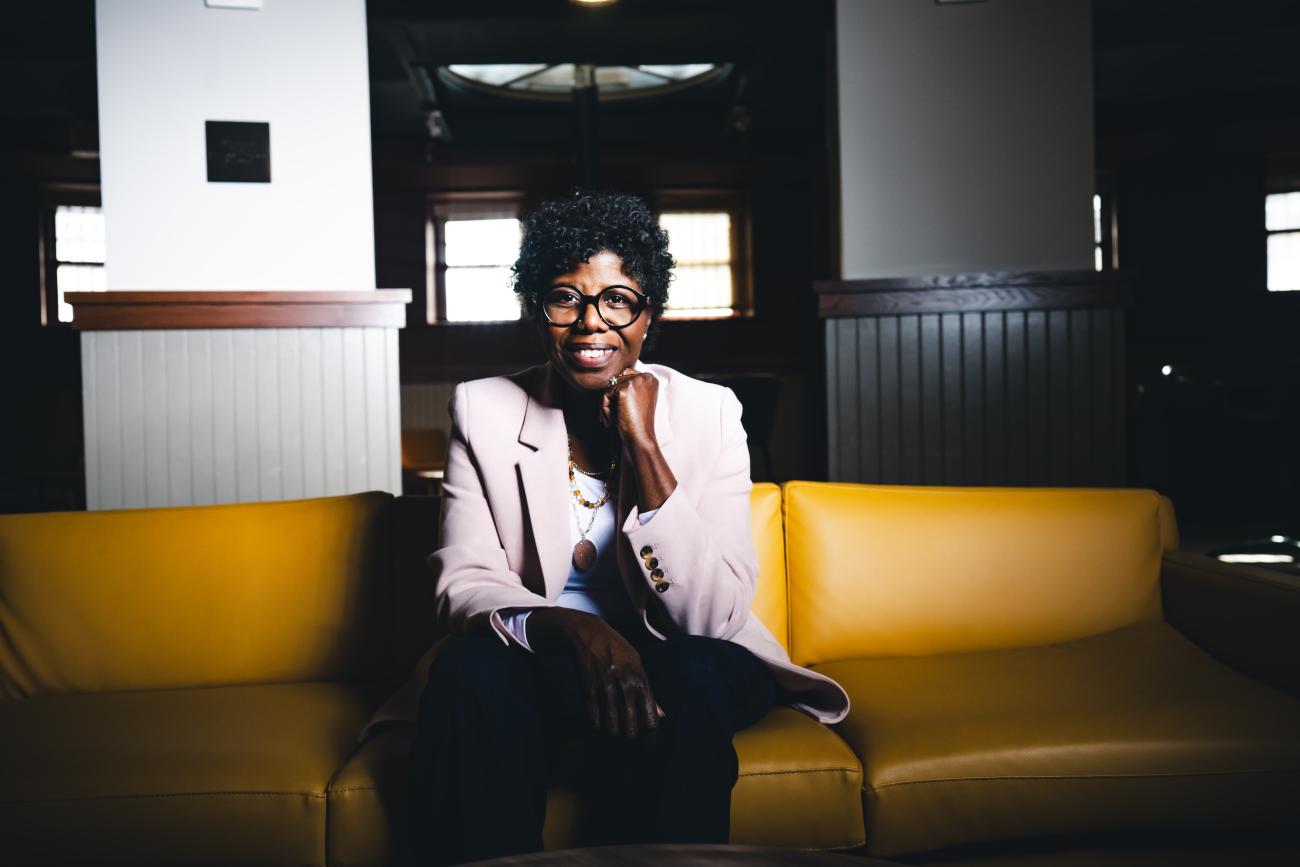
Robin Sundaramoorthy always wanted to work in radio. Now an assistant professor in Lehigh’s department of journalism and communication, her love of the broadcast medium began when her parents were going through a divorce and she lived for a time with her grandparents, who listened to the radio constantly.
“Radio was my first love,” Sundaramoorthy says. “It was my friend; I loved the fact that the voices on the radio could just take me to another place.”
Sundaramoorthy, who received her bachelor's degrees in English and mass communication from Newberry College in South Carolina, never worked in radio professionally, but two prominent internships proved foundational to her journalism career. At South Carolina's #1 talk radio station and the local NPR affiliate, she learned to write news stories for both broadcast and print—skills that would define her work for decades. Both positions came with significant responsibility and provided her with firsthand knowledge about how the news industry operates. After earning her master's in journalism from Michigan State University, she spent 20 years in television journalism, starting in Michigan on the overnight weekend shift.
Fortunately, Sundaramoorthy would eventually return to her first love, making it the topic of her doctoral dissertation in 2024 at the University of Maryland. That dissertation, “Black Radio Ownership and the FCC’s Failed Attempt to Diversify the Airwaves,” won awards from the American Journalism Historians Association and the Broadcasters Education Association, and received the highly prestigious Gerald R. Miller Outstanding Doctoral Dissertation Award from the National Communication Association this year.
A Long and Winding Road
The road back to radio was winding but rewarding. Sundaramoorthy worked in various production roles at local news stations before joining CNN, where she served as associate producer and producer for CNN International and CNN Airport Network. These experiences equipped her to move to the Christian Broadcasting Network, where she became Washington, D.C. bureau chief in 2011—the first Black person and first woman to hold the position. “I had a great career, I traveled across the United States and all over the world,” Sundaramoorthy says. “I covered then-Senator Barack Obama when he was running for president. I was in Grant Park the night President Obama won, interviewing people in the crowd.”
During that time, however, the journalism industry was irrevocably changing. The traditional business model of print advertising had cratered; local newsrooms continued to either shutdown or merge; and social media platforms like Facebook and X (formerly Twitter) started becoming the primary news sources for more and more people.
For Sundaramoorthy, it was time for a change, too. She left CBN, got married, had a child, and began teaching classes at Trinity Washington University in Washington, D.C., as an adjunct professor. That experience rekindled her interest in getting her PhD.
So, with her master’s in journalism from Michigan State University in hand, and twenty years of lived experience in the industry, Sundaramoorthy began her doctoral studies at the University of Maryland.
Barriers to Entry
The specific dissertation topic Sundaramoorthy decided to focus on was the federal government’s efforts to increase minority broadcast ownership by increasing the number of FM radio stations in the early 1980s, a push that began when Jimmy Carter was elected president in 1976.
Sundaramoorthy says Carter had won the Black vote overwhelmingly, and he felt he needed to repay the Black community in some way. One way he proposed to do that was to try and increase minority broadcast ownership.
“In 1968 there were only five Black-owned radio stations,” Sundaramoorthy says. “By 1978 there were 62, so less than 1 percent of all radio stations in the country were owned by African Americans.”
Though Carter would leave office before he saw his plan come to fruition, in 1983 the FCC issued Docket No. 80-90. This rule ultimately led to the creation of approximately 700 new FM stations in small- to mid-sized communities across the country.
While the rule forever altered the landscape of FM radio, Sundaramoorthy found through her research that efforts to increase minority broadcast ownership had been stymied by a convoluted combination of economic policy, judicial rulings and political maneuvering by the party that controls the White House.
“From the 1930s up until shortly after Carter was elected, there were so many policies in place that prevented minorities and women from entering into ownership,” Sundaramoorthy. “The airwaves were free, but the FCC grants the licenses, and a lot of structural racism prevented Black people from entering the industry.”
Sundaramoorthy learned that applicants for those licenses had to have previous experience in the broadcast field which, of course, most Black Americans didn't have because they didn’t have access to those types of opportunities.
At the same time, there were onerous financial requirements, such as buying the land and equipment, as well as having to have three or four months of operating expenses on hand, before being able to go on the air.
Stories Behind the Data
Because this historical episode occurred relatively recently, Sundaramoorthy was able to locate nine Black individuals who benefited from Docket No. 80-90 and built radio stations from the ground up. Uncovering their stories required exhaustive investigative work: she conducted 50 interviews and meticulously reviewed more than 7,000 documents from the National Archives—a level of research depth and rigor that judges have consistently recognized in the awards she has received for this work. “They all had very similar experiences,” Sundaramoorthy says. “A difficult part of Docket No. 80-90 was that, in order to acquire these stations, you had to go through what was called a ‘comparative hearing’ where there was an actual judge who would look at all of these people who wanted to acquire the signal. In some cases, there were more than two dozen people vying for the same signal.
“They would have to go to court over and over again to make their case.”
Sundaramoorthy discovered that it took one owner, Paula Nelson, ten years to acquire her station in Sacramento, Calif. She went to court dozens of times and was awarded the station only to have someone challenge her—so she had to go to court yet again.
“She eventually won the hearing and the license,” Sundaramoorthy says. “The last gentleman to challenge her ended up getting cancer and passing away before he could build a station, so when she went to court again she finally won the license.”
The comparative hearing process was extremely expensive. Sundaramoorthy says Black applicants spent hundreds of thousands of dollars to acquire their stations.
“Most of them remained in the hands of the original African American owner for five years before they were sold because of consolidation pressures and the Telecommunications Act of 1996,” Sundaramoorthy says, “so they were able to become financially viable. And all the stations were wildly successful—they all either had a jazz or an urban radio format, and shot to number one in these markets almost overnight. It was pretty amazing.”
“I really just hope that I've done justice to the people whose stories I've told,” Sundaramoorthy added. “When I was a working journalist, I tried to represent the people I met with honesty and respect and that's what I'm hoping I've done for these amazing men and women.”
The Path Ahead
Since completing her doctorate and becoming an assistant professor at Lehigh, Sundaramoorthy’s research has focused on what happens when mainstream media outlets misrepresent or ignore minority communities. Her work specifically examines Black media, the Black Press, and the Federal Communications Commission (FCC), with particular attention to how media policy and ownership shape representation and voice in society.
“I love media and journalism history,” Sundaramoorthy says, “and I love the methods I use—oral history and archival research—because honestly it's just like I'm still producing news stories.”
“Of course, I'm more in depth now,” Sundaramoorthy continued. “I'm adding theory and a few other things I wouldn't necessarily have done when I was a TV news journalist, but this whole journey has been absolutely incredible.”
Outside of her academic career, Sundaramoorthy is exploring the professional and personal possibilities of the new media that were just emerging when she was a practicing journalist.
“I'm working with a friend at Towson University on a proposal for a podcast that we're trying to put together,” Sundaramoorthy says. “We're going to be looking at Black women in academia, producing a podcast that will provide career tips and advice, as well as a space for African American women and their allies.”